By The Features Desk
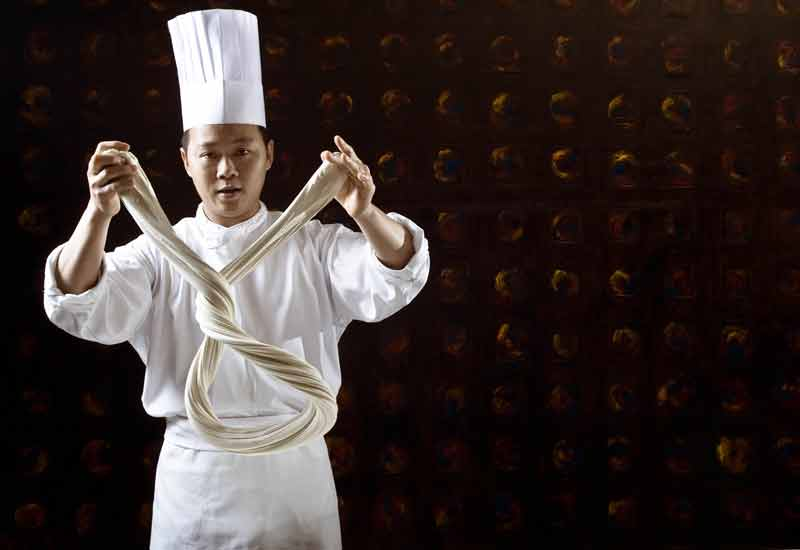
BEIJING — In the shadow of glass-paneled skyscrapers in modern-day Chengdu, a vendor stretches a piece of dough with rhythmic, almost hypnotic precision. The resounding thwack of the dough hitting a wooden board echoes a culinary tradition that has survived empires, famines, and the industrial revolution.
While archaeologists in 2005 unearthed a 4,000-year-old bowl of millet noodles perfectly preserved beneath the overturned sediment of the Lajia archaeological site, the modern noodle—the wheat-based staple we recognize today—began its true cultural ascent roughly two millennia ago.
It is a story of how a utilitarian “soup cake” evolved from the exclusive banquets of emperors to the bustling, neon-lit street stalls that define global urban landscapes today.
The Wheat Revolution
For much of ancient Chinese history, indigenous grains like millet were the cornerstone of the diet. The turning point arrived during the Han Dynasty (206 BCE – 220 CE) with the advent of large-scale stone milling. Wheat, which had previously been boiled as a whole grain into a rather uninspiring porridge, could suddenly be ground into fine flour.
Early historical texts refer to these proto-noodles not as mian (the modern term for noodles), but as tangbing, or “soup cakes.” These early iterations were less about the delicate strands seen today and more about torn scraps of dough dropped into boiling broth. Yet, this simple innovation fundamentally shifted the culinary trajectory of Asia.
By the time the Tang Dynasty (618–907 CE) established its cosmopolitan capital in Chang’an (modern Xi’an), noodles had transitioned from mere sustenance to symbols of cultural sophistication. It was during this era that the concept of changshou mian—longevity noodles—took root. Served at birthdays and New Year celebrations, the unbroken, elongated strands became an edible metaphor for a long and prosperous life.
The Culinary Democratization
If the Tang Dynasty gave noodles their symbolic weight, the Song Dynasty (960–1279 CE) gave them to the people.
The Song era witnessed an unprecedented boom in urbanization and the abolition of strict curfews. In sprawling metropolises like Kaifeng and later Hangzhou, night markets flourished. For the first time, historical records meticulously detail a thriving street food culture where ordinary citizens, merchants, and scholars rubbed shoulders at wooden carts. Noodle shops became the great equalizers of Chinese society.
“During the Song Dynasty, noodles evolved from an imperial indulgence to the fast food of the urban working class,” notes culinary historian Dr. H.T. Huang. “You begin to see specialized vendors selling cold noodles, vegetarian noodles, and intricate meat-topped broths.”
Milestones in Noodle History
Han Dynasty (206 BCE – 220 CE)
2000 Years Ago
Large-scale stone milling is introduced. Wheat flour dough is torn into boiling water, creating tangbing (soup cakes), the ancestor of modern wheat noodles.
Tang Dynasty (618–907 CE)
1400 Years Ago
Noodles gain ceremonial significance. The tradition of serving long, uncut noodles to symbolize longevity and good fortune begins in royal courts and affluent households.
Song Dynasty (960–1279 CE)
1000 Years Ago
Urban night markets emerge in cities like Kaifeng. Noodle stalls proliferate, creating the first true street food culture and democratizing the dish for the working class.
19th–20th Century
Modern Era
The Chinese diaspora carries regional noodle techniques across the globe, leading to localized adaptations such as Japanese ramen, Southeast Asian laksa, and American chow mein.
The Global Migration
The regional diversity of the Chinese noodle is staggering, driven by geography and climate. In the arid north, where wheat thrives, you find the robust, chewy daoxiao mian (knife-cut noodles) of Shanxi and the legendary lamian (hand-pulled noodles) of Lanzhou. In the humid south, rice takes precedence, giving birth to the delicate, translucent mifen (rice vermicelli).
As trade routes expanded—most notably the Silk Road—so too did the noodle’s influence. While the debate over whether Marco Polo brought pasta to Italy has been largely debunked by historians, there is no denying the profound impact Chinese migrants had on neighboring Asian cuisines.
When waves of laborers from Guangdong and Fujian provinces migrated in the 19th and 20th centuries, they packed their culinary heritage in their luggage. The lamian of Chinese immigrants in Japan slowly transformed into the globally ubiquitous ramen. The wok-tossed street foods of Hokkien immigrants became the foundation for dishes ranging from Filipino pancit to Indonesian bakmi.
Today, the 2,000-year evolution of the Chinese noodle serves as a testament to the power of adaptation. Whether it is an immaculately plated abalone noodle dish in a Michelin-starred restaurant in Hong Kong, or a humble, fiery bowl of dandan mian served on a plastic stool in a Sichuan alleyway, the noodle remains a masterclass in simplicity, resilience, and design.
Leave a Reply