Author: Mark Malachy

  • 5 Wok Techniques Chinese Chefs Use to Master Perfect Chow Mein

    By The Features Desk

    CANTON, China — In the high-octane kitchens of Guangdong province, the line between culinary skill and physical performance disappears behind a wall of roaring flame. Standing before jet-engine burners operating at upwards of 100,000 BTUs, Cantonese stir-fry chefs maneuver heavy carbon-steel woks with rhythmic, explosive precision.

    While amateur cooks often view Chow Mein as a simple assembly of tossed noodles, soy sauce, and vegetables, professional Chinese chefs view it as a high-stakes test of thermal management. Achieving the elusive Wok Hei—the coveted “breath of the wok”—requires mastering five distinct physical and culinary techniques developed over centuries of Cantonese kitchen tradition.

    1. Long Yau: Seasoning the Steel with Thermal Shock

    Before a single strand of noodle touches the wok, a master chef executes Long Yau (literally “passing oil”). The carbon-steel wok is heated over intense flame until it glows faint red and smokes profusely, opening the microscopic pores of the metal.

    The chef ladles room-temperature cooking oil into the smoking wok, swirls it around the entire inner surface, and immediately pours the hot oil back into a holding pot. Fresh, cool oil is then added before cooking begins. This rapid temperature contrast creates a temporary, non-stick polymer barrier on the unvarnished steel. For Chow Mein, this step is non-negotiable; without it, the high starch content of the noodles instantly scorches and bonds to the hot metal, ruining the dish.

    2. Par-Boiling and Air-Drying: Managing Water Activity

    The biggest mistake in home noodle making is introducing excess moisture into the wok. Steam is the enemy of stir-frying; it lowers the internal temperature of the vessel, changing the cooking process from searing to boiling.

    To achieve crisp, distinct noodles, chefs first par-boil fresh egg noodles until they are 80 percent cooked. They are immediately drained, tossed with a thin film of neutral oil, and spread across wide bamboo trays. The noodles are then subjected to high-speed air currents or left to cool completely for several hours. This dehydrates the outer starch layer, ensuring that when the noodles hit the hot oil, they crisp on contact rather than releasing moisture.

    3. Pan-Frying the Noodle Cake: Building Structural Crispness

    Authentic Cantonese Chow Mein comes in two distinct forms: soft (Chao Mian) and crispy (Liang Mian Huang, or “two-sided yellow”). For the crispy variant, chefs do not stir the noodles immediately upon adding them to the wok.

    Instead, the air-dried noodles are arranged into a flat, circular disc along the bottom and sloped walls of the oiled wok. The chef rotates the wok in a continuous, tilting motion over the central flame, ensuring even heat distribution across the entire base. This creates a golden, glass-like crust on the outside while maintaining a soft, chewy interior. Only after this base is set are the noodles flipped to sear the opposing side.

    Technique PhasePrimary ObjectivePhysical Mechanism
    Long YauNon-stick surface preparationOil polymerization opens/seals steel pores via thermal shock
    Air-DryingSurface moisture eliminationDehydrates surface starches to prevent steam creation
    Pan-FryingDual-texture creationMaillard reaction forms crisp outer shell around soft interior
    Wok Toss (Pao Wok)Thermal oxidation & Wok HeiSuspends oil droplets in air, catching flame to vaporize fat
    Periphery GlazingAromatic flash-caramelizationHigh-wall heat rapidly burns off moisture, leaving concentrated umami

    4. Pao Wok: The Aerodynamic Pursuit of Wok Hei

    The signature flavor of a elite Chow Mein is Wok Hei, an aromatic profile created by the Maillard reaction, caramelization of sugars, and the thermal breakdown of fat droplets suspended in the air.

    Achieving this requires Pao Wok—the aggressive tossing motion that pushes food up the curved back wall of the wok and into the air. As the oil-coated noodles fly above the rim, they pass through a column of superheated gas rising from the burner. Microscopic droplets of aerosolized oil ignite momentarily in the air, creating a subtle combustion that infuses the noodles with a smoky, charred aroma without burning the food itself.

    5. Periphery Glazing: Flash-Caramelizing the Seasoning

    The final phase of executing perfect Chow Mein lies in how liquid seasoning is applied. A master chef never pours soy sauce, Shaoxing wine, or sesame oil directly onto the pile of noodles in the center of the wok. Doing so drastically lowers the temperature of the food and washes away the crisp crust.

    Instead, liquid seasonings are splashed directly against the bare, glowing-hot upper rim of the carbon-steel wok (periphery glazing). As the sauce trickles down the searing vertical walls, its water content instantly vaporizes, leaving behind concentrated, partially caramelized soy solids that cling to the noodles as they are tossed through the center. The result is a dry, fragrant finish where every strand is coated in deep umami without a drop of pooled liquid at the bottom of the plate.
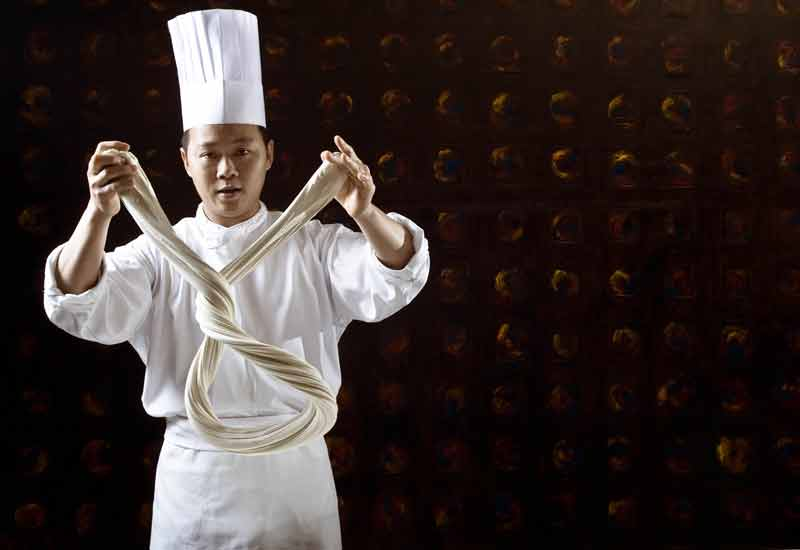
  • The Chemistry of Alkaline Water: Why Chinese Noodles Have That Addictive Chew

    By The World Desk

    BEIJING — In the world of gastronomy, texture is often as powerful as taste. Long before a diner registers the aromatics of a boiling broth or the bite of chili oil, their teeth encounter a physical resistance—a springy, elastic snap that food scientists in Asia refer to as Q or Q-弹 (Q-elastic).

    While Western pasta strives for an al dente core encased in soft wheat, traditional Chinese noodles strive for a uniform, rubbery resilience that holds its structure even after sitting in piping-hot soup.

    That addictive chew is not the result of secret kneading techniques or magical flours. It is the result of precise organic chemistry, driven by an ancient technique: raising the pH level of dough using alkaline water.

    The Molecular Battle for Gluten Structure

    To understand why alkaline noodles behave differently, one must look at what happens inside dough at a microscopic level.

    Flour contains two key proteins: gliadin, which gives dough its extensibility (the ability to stretch), and glutenin, which provides elasticity (the ability to snap back). When water is added to flour, these proteins cross-link to form a three-dimensional net called gluten.

    In neutral or slightly acidic water (around pH 5 to 7), this gluten network forms loosely. Under the microscope, the protein strands are somewhat tangled, allowing water to penetrate easily and starches to swell during boiling, resulting in a softer, starchier noodle.

    When alkaline water is introduced—raising the pH to between 9 and 11—a dramatic chemical transformation occurs:

    1. Protein Cross-Linking: The basic environment alters the electrical charge of the amino acids within the proteins. This forces the glutenin and gliadin to form tighter, far more rigid disulfide bonds with one another.
    2. Starch Gelatinization Inhibition: The elevated pH restricts the starch granules in the wheat from absorbing water too quickly and breaking open, preventing the noodle from turning mushy.
    3. Flavonavoid Pigment Activation: Naturally occurring, colorless flavonoid compounds in the wheat flour react to the alkaline environment, turning a pale, vibrant yellow without the addition of eggs or artificial dye.

    From Desert Lakes to Modern Science

    Long before modern chemists understood pH scales, ancient cooks in northern China discovered this phenomenon by necessity.

    In regions like Shaanxi and Gansu, cooks noticed that dough mixed with water drawn from certain naturally occurring alkaline lakes—rich in sodium carbonate and potassium carbonate salts—yielded far tougher, springier noodles. In Lanzhou, cooks harvested peng hui, the ash of desert plants growing in alkaline-rich soil, to achieve the same effect.

    In Cantonese culinary traditions, this alkaline solution is known as Lye Water or Kansui (kan-sui), a precise mixture of sodium carbonate ($Na_2CO_3$) and potassium carbonate ($K_2CO_3$).

    Noodle TypeWater pH LevelTexture ProfileVisual Characteristics
    Standard Wheat NoodleNeutral (pH 6.0 – 7.0)Soft, tender, breaks easilyPale white, opaque
    Alkaline Hand-Pulled (Lamian)Medium Alkaline (pH 8.5 – 9.5)Highly elastic, smooth, stretchableCreamy yellow, slightly glossy
    Cantonese Egg / Wonton NoodleHigh Alkaline (pH 10.0 – 11.0)Extremely firm, snappy, rubberyBright yellow, translucent appearance
    Japanese Ramen (Kansui-based)High Alkaline (pH 9.5 – 10.5)Chewy, springy, resistant to brothYellow hue, distinct alkaline aroma

    The Flavor and Preservation Side Effects

    Beyond structural integrity, raising the pH alters the sensory profile of the noodle in two distinct ways.

    First, the alkaline treatment imparts a subtle, slippery mouthfeel and a unique, slightly sulfurous or soapy aroma that enthusiasts instantly recognize. This alkaline scent serves as a bitter counterweight to rich, fatty pork or beef broths, cutting through heavy oils on the palate.

    Second, the high pH acts as a natural preservative. Bacteria and mold struggle to proliferate in basic environments. By altering the chemistry of the dough, historical cooks were able to store fresh noodles for longer periods without refrigeration in humid tropical climates like Guangdong and Hong Kong.

    What began thousands of years ago as a empirical observation near salty desert lakes has evolved into an exact industrial science. Whether in a Michelin-starred wonton shop in Hong Kong or a bustling street cart in Lanzhou, the addictive bite of a Chinese noodle remains a triumph of ancient chemical engineering.

  • Wuhan Hot Dry Noodles: The Breakfast Staple That Fueled a Culinary Revolution

    By The World Desk

    WUHAN, China — In the humid, early-morning air of Hubei province, the city of Wuhan awakens to a singular, collective impulse known locally as guo zao—literally, “passing the morning.”

    Long before the sun rises fully over the Yangtze River, thousands of street vendors operate at blistering speed, blanching pre-cooked noodles, dashing spoonfuls of dark soy sauce, and drizzling rich, velvety sesame paste over steaming bowls.

    The result is Reganmian, or Hot Dry Noodles. Unlike the delicate soup noodles of southern China or the thick broth-laden bowls of the north, Wuhan’s signature dish is proudly, unapologetically dry.

    It is a meal engineered for efficiency, born at the intersection of extreme geography, industrial labor, and a mid-20th-century culinary accident that permanently redefined Chinese breakfast culture.

    The Science of the “Dry” Noodle

    The defining feature of Reganmian lies in its two-stage preparation process—a technique designed specifically to survive the sweltering heat of Wuhan’s summers, historically known as one of China’s “Four Great Furnaces.”

    In traditional noodle making, fresh dough spoils rapidly in high humidity. To combat this, Wuhan cooks developed an ingenious preservation method:

    1. Parboiling: The high-gluten wheat noodles are boiled briefly until nearly cooked through, then immediately drained.
    2. Oil Coating: The hot noodles are spread thinly over large bamboo mats, tossed generously with sesame oil, and fan-cooled. This coats each strand, stopping the cooking process and preventing the starches from sticking together.
    3. Flash-Blanching: When a customer orders, the oiled noodles are submerged in boiling water for merely 6 to 10 seconds—just long enough to heat them through without making them soggy.

    The Accidental Invention

    Culinary lore traces the dish to the 1930s and a street vendor named Li Bao in Wuhan’s Hankou district.

    Faced with a humid summer day and a large surplus of unsold boiled noodles, Li Bao worried the batch would sour. To preserve them, he poured leftover sesame oil over the noodles and spread them out to dry.

    The following morning, he flash-blanched the pre-oiled noodles and served them topped with a thick paste made from toasted sesame seeds, garlic, pickled radish, and chili oil. The local dockworkers and factory laborers rushed to buy the new creation. It was cheap, highly caloric, fast to prepare, and portable enough to eat while walking to the shipyards.

    ComponentRole in ReganmianCulinary Function
    Alkaline Wheat NoodleStructural baseFirm, chewy texture (q-弹) that holds up under thick sauces without becoming mushy.
    Toasted Sesame PastePrimary aromatic & binderProvides dense calories, fat, and a nutty coat that clings to every strand.
    Pickled Long Beans/RadishTextural contrastDelivers an acidic, crunchy bite (zha cai) that cuts through the rich sesame fat.
    Dark Soy & Chili OilSeasoning layerAdds umami depth, color, and a sharp thermal heat to stimulate appetite in humid weather.

    The Industrial Engine of the Yangtze

    The rapid rise of Hot Dry Noodles mirrors the industrial growth of Wuhan itself. As a major inland port and railway hub along the Yangtze River, Wuhan relied heavily on manual labor throughout the 19th and 20th centuries.

    Dockworkers unloading cargo along the riverbanks needed a breakfast that was energy-dense and consumed quickly. Reganmian provided a massive burst of carbohydrates and healthy fats from sesame seeds in a vessel that could be prepared in under 30 seconds.

    Over the decades, guo zao transformed from a simple necessity into a vibrant civic lifestyle. Today, Wuhan boasts one of the most intense breakfast cultures in Asia, with Reganmian standing at the center as a symbol of the city’s blue-collar resilience and unpretentious heritage.

    From humble roadside carts to national chains across China, the dish remains a masterclass in culinary functionalism—turning an accidental preservation trick into an iconic pillar of global food culture.

  • Beyond Ramen: How Chinese Lamian Inspired Japan’s Favorite Comfort Food

    By The World Desk

    YOKOHAMA, Japan — Step into the subterranean maze of the Shinyokohama Ramen Museum, and you step into a meticulous recreation of Tokyo’s downtown streets circa 1958. Steam rises from rows of wooden counters as diners hunch over steaming bowls of rich, pork-bone broth and springy yellow noodles.

    Today, ramen is universally celebrated as the undisputed heavyweight of Japanese comfort food—a national icon exported across the globe as a symbol of Japanese culinary precision.

    Yet, stripped of its modern branding, ramen is a dish born of migration, labor, and cross-cultural adaptation. Its lineage traces back not to the imperial courts of Kyoto, but to the bustling port cities of late 19th-century Japan, where Chinese immigrants adapted their native lamian (hand-pulled wheat noodles) to feed a rapidly industrializing Japanese working class.

    The Port City Origins

    The story of ramen begins in 1859, when Japan ended two centuries of national isolation under the Tokugawa shogunate by opening port cities like Yokohama, Kobe, and Nagasaki to foreign trade. Among the merchants, traders, and sailors who arrived were Chinese laborers, predominantly from Guangdong and Fujian provinces.

    These migrants established vibrant Chinatowns (Chukagai) within the port districts, bringing with them street food traditions from southern China. Early street stalls served a simple noodle dish known as Nanjing soba or Shina soba (“Chinese buckwheat noodles”—though the noodles were made entirely of wheat flour).

    Unlike indigenous Japanese noodles such as buckwheat soba or thick wheat udon, which were traditionally served in light, dashi-based kelp broths, this foreign import featured a heartier, meat-based broth seasoned with salt or soy sauce and topped with sliced roasted pork (chashu).

    The Chemical Transformation: Kansui

    The definitive structural evolution that separated Japanese ramen from its Chinese ancestor lay in a single, critical ingredient: kansui.

    In traditional Chinese lamian making, dough elasticity is achieved through manual stretching, pounding, and occasionally adding alkaline ash (peng hui). When Japanese shop owners began commercializing the dish, they standardized the dough by incorporating kansui—an alkaline mineral water rich in potassium carbonate and sodium carbonate.

    CharacteristicTraditional Chinese LamianJapanese Ramen
    Dough PreparationHand-pulled and stretched to orderRolled, sheeted, and cut using mechanical cutters
    Alkaline AgentPeng hui (plant ash) or sodium bicarbonateKansui (potassium/sodium carbonate mineral solution)
    Noodle TextureSoft, elastic, smooth, slipperyFirm, springy, chewy (koshi), yellow-hued
    Broth ProfileLight, aromatic beef or chicken bone brothsDense, heavily reduced tonkotsu, miso, or shoyu bases

    The reaction between kansui and the proteins in wheat flour gives ramen noodles their signature yellowish tint, distinctly firm bite, and a unique aroma. Crucially, the alkaline treatment prevents the noodles from softening too quickly when submerged in piping-hot, fat-rich broths.

    Rai-Rai-Ken and the Birth of a Industry

    While port stalls fed dockworkers for decades, the birth of the modern Japanese ramen industry occurred in 1910 in Tokyo’s Asakusa district with the opening of Rai-Rai-Ken.

    Founded by Kanichi Tzuda, a former customs official who hired twelve Chinese cooks from Yokohama’s Chinatown, Rai-Rai-Ken served a hybrid dish tailored specifically to the Japanese palate. The kitchen combined Chinese-style wheat noodles with a broth infused with traditional Japanese soy sauce (shoyu) and dashi stock.

    The restaurant was an instant commercial triumph, reportedly serving up to 3,000 customers a day during peak holidays. It established the template for the modern ramen-ya (ramen shop) and triggered a nationwide proliferation of noodle carts (yatai) across Tokyo and Osaka.

    Post-War Industrialization and Global Conquest

    The devastating shortages of World War II nearly wiped out the trade, as flour was strictly rationed and street stalls were outlawed. However, during the post-war U.S. occupation, large shipments of cheap American wheat flooded the Japanese market to stave off widespread famine.

    Black-market food stalls reemerged, utilizing cheap wheat flour to feed returning soldiers and factory laborers rebuilding the nation’s infrastructure. It was during this era that regional variations exploded across the archipelago:

    • Hokkaido: Rich, hearty Miso Ramen designed to combat freezing northern winters.
    • Fukuoka (Kyushu): Milky, collagen-rich Tonkotsu (pork bone) broth born in street stalls near docks.
    • Tokyo: Refined, clear Shoyu broth balanced with dried seafood and chicken.

    The trajectory of the dish was permanently altered in 1958 when Momofuku Ando, founder of Nissin Foods, invented instant chicken ramen. By converting a fresh street-food dish into a shelf-stable, industrial staple, Ando democratized the meal globally.

    From its humble origins as an inexpensive street food sold by Chinese migrants to sustain dock workers, ramen has undergone a 150-year journey of technical refinement. Today, as Michelin-starred ramen shops draw long queues in Tokyo and New York, the dish stands as a testament to how culinary borrowing, combined with rigorous industrial design, can elevate foreign inspiration into a global phenomenon.

  • Biang Biang Noodles: The Untold Story of Shaanxi’s Most Famous Belt-Width Dish

    By The Features Desk

    XI’AN, China — In the sprawling, historic capital of Shaanxi province, a dish is defined not just by its flavor, but by its auditory footprint. As a chef grasps the ends of a thick, oily dough and slaps it rhythmically against a wooden prep table, the resounding biang, biang echoes through the alleyways.

    This onomatopoeic thwack gave birth to biang biang noodles—a regional staple so wide it is often compared to a leather belt. But the story of this dish is more than a culinary curiosity; it is a profound narrative of agrarian resilience, geographical destiny, and the most complex character in the Chinese lexicon.

    Geography as Destiny

    To understand the sheer heft of a biang biang noodle, one must first understand the soil from which it springs.

    Shaanxi province sits at the crossroads of China’s climatic divide. Its northern half is dominated by the arid, loess plateau, while the Guanzhong plain in the center acts as a fertile cradle for winter wheat. Unlike the delicate, rice-based noodles of southern China, which evolved in humid, water-rich environments, Shaanxi’s noodles are a product of caloric necessity. For centuries, laborers needed food that was dense, durable, and capable of sustaining them through grueling agricultural work.

    The wheat grown in the Guanzhong plain is exceptionally high in gluten. When milled and kneaded, it produces a dough with an iron-clad structure. Instead of being delicately pulled into thin strands like Lanzhou lamian, this dough is flattened, stretched wide, and torn down the middle to create ribbons that can be up to three feet long.

    The Linguistics of a Noodle

    Perhaps the most fascinating aspect of biang biang noodles is not found in the bowl, but on the menu.

    The character for biang is infamous among linguists and native speakers alike. It does not exist in standard dictionaries, nor can it be easily typed on a modern keyboard. Comprising nearly 60 strokes, it is an invented ideogram—a Frankenstein’s monster of Chinese calligraphy created specifically for this local street food.

    Linguists theorize that the character was devised centuries ago as a clever marketing gimmick by a roadside vendor looking to attract passing scholars and imperial officials. The character is an amalgamation of smaller components meaning “moon,” “horse,” “spear,” “silk,” and “walk.” To remember how to write it, Shaanxi locals recite a traditional mnemonic poem that traces the strokes, turning the act of writing the noodle’s name into a cultural rite of passage.

    “The biang character is a linguistic anomaly,” explains Dr. Wei Chen, a researcher in Chinese sociolinguistics. “It operates outside the official bureaucratic systems of language, surviving purely through oral tradition and street-level commerce. It is food defining language, rather than the other way around.”

    The Anatomy of the Bowl

    While the noodle itself is the foundation, the execution of a perfect bowl of biang biang mian relies on a specific sequence of assembly. The dish is famously served you po style—literally “oil-splashed.”

    1. The Base: The thick, chewy noodles are boiled and laid in a wide bowl, serving as a starchy canvas.
    2. The Aromatics: A small mountain of minced garlic, scallions, and a generous heap of local Shaanxi ground chili flakes is placed directly on top of the bare noodles.
    3. The Flash: The chef heats rapeseed oil in a wok until it reaches a smoking point of roughly 400°F (200°C).
    4. The Splash: The blistering oil is poured directly over the raw aromatics. The instantaneous searing releases the essential oils of the chili and garlic, creating a violent, sizzling emulsion that coats every inch of the wide noodles.
    5. The Acid: A dash of mature black vinegar is quickly splashed into the bowl to cut through the heavy oil and provide a bright, acidic finish.

    In an era of mass-produced, freeze-dried ramen, biang biang noodles remain stubbornly artisanal. You cannot easily package a three-foot-long, hand-slapped noodle, nor can you replicate the visceral thrill of smoking oil hitting raw chili powder in a factory. It remains a dish anchored to its geography—a heavy, satisfying bite of Shaanxi’s history.

  • Crossing-the-Bridge Rice Noodles: Yunnan’s Most Romantic Culinary Legend

    By The News & Features Desk

    GUILIN, China — In the mist-shrouded limestone karsts of Guangxi province, a distinct, pungent aroma wafts through the night markets of Liuzhou. It is a scent that visitors frequently describe as overwhelming—a sharp, funky, fermented odor that halts uninitiated tourists in their tracks.

    Yet, this polarizing broth is the foundation of luosifen (snail rice noodles), a regional street food that has unexpectedly transformed into one of the most lucrative e-commerce phenomena in modern Chinese culinary history.

    Over the past decade, a humble local dish traditionally served at roadside stalls has evolved into a multi-billion-dollar packaged food industry. Driven by viral social media campaigns, live-stream commerce, and a surge in home-cooking during global lockdowns, luosifen stands as a masterclass in how hyper-regional comfort food can be industrialized for a digital generation without losing its traditional soul.

    The Anatomy of the Stench

    To understand the global rise of luosifen, one must first dismantle the misconception surrounding its primary ingredient. Contrary to popular belief, the dish rarely contains actual snail meat.

    The broth is crafted by simmering river snails alongside pork bones, cardamom, star anise, fennel seeds, dried tangerine peel, and a heavy hand of chili peppers for upwards of ten hours. The snails dissolve into the liquid, imparting a rich, savory umami base packed with natural glutamates.

    However, the dish’s notorious scent does not originate from the snails or the spices. The primary culprit is suansun—fermented sour bamboo shoots.

    IngredientRole in the DishFlavor & Chemical Impact
    Fermented Bamboo (Suansun)Primary aromatic anchorUndergoes anaerobic fermentation, producing volatile organic compounds like butyric acid, giving the dish its signature pungent aroma.
    River Snail & Bone BrothLiquid foundationProvides deep umami richness and lipid structure that coats the chewy rice noodles.
    Chili Oil & VinegarAcidic counterweightHigh-heat chili oil cuts through the funk, while aged vinegar balances the richness of the broth.
    Fried Yuba (Bean Curd Skin)Textural elementCrispy sheets absorb the spiced broth, offering a crunch that contrasts with soft rice noodles.

    From Night Market Stalls to E-Commerce Dominance

    For decades, luosifen remained a strictly local affair, consumed almost exclusively within Guangxi. Its journey toward national dominance began around 2014, when local entrepreneurs perfected a method to mass-produce dehydrated rice noodles and vacuum-pack the broth, chili oil, and fermented toppings into instant food kits.

    The timing coincided with the rapid expansion of China’s live-stream shopping platforms. Influencers and digital creators began broadcasting “eating shows” (mukbangs), challenging themselves to consume the notoriously smelly dish on camera. The viral intrigue surrounding its smell created an overnight sensation among Gen Z consumers.

    According to government industrial data, the instant luosifen sector in Liuzhou generated over 20 billion yuan (approximately $2.8 billion USD) in annual sales by the mid-2020s, with packages exported to over 20 countries across North America, Europe, and Southeast Asia. Local municipal governments stepped in to standardize manufacturing quality, securing a Protected Geographical Indication tag to protect the authenticity of the dish.

    The phenomenon represents a permanent shift in how traditional culinary heritage is preserved and monetized. By leveraging modern food science and digital supply chains, a dish once confined to a remote river city has established itself as an undeniable icon of global food culture.

  • Why Lanzhou Beef Noodle Masters Train for Years Just to Stretch Dough

    LANZHOU, China — In the sweltering, steam-filled kitchens of Gansu province, the rhythm of breakfast is dictated by a sound: the aggressive, rhythmic slap of dough hitting a floured steel counter.

    Within ten seconds, a single cylinder of dough is stretched, folded, and spun between the fingers of a master chef until it magically multiplies into thousands of hair-thin strands. It is a spectacle that has captivated diners and tourists for decades. But behind this fleeting culinary magic lies an arduous, multi-year apprenticeship that breaks many before they ever pull a single noodle for a paying customer.

    The art of Lanzhou lamian (hand-pulled noodles) is not merely a cooking technique; it is a brutal mastery of physics, chemistry, and human endurance.

    The Chemistry of the Stretch

    To understand why it takes years to learn how to stretch dough, one must understand the volatile nature of gluten.

    Wheat flour, when mixed with water, forms gluten networks—complex protein structures that provide dough with its elasticity. In Western baking, yeast and long resting periods are used to relax these proteins. In Lanzhou noodle making, chefs must achieve an extraordinary level of extensibility almost instantly.

    The secret lies in peng hui, a traditional alkaline ash derived from the desert halophyte plant Halogeton arachnoideus. The addition of this alkaline agent fundamentally alters the pH of the dough, tightening the protein bonds and allowing the dough to stretch to extreme lengths without tearing.

    However, there is no standardized recipe. A noodle master must adjust the hydration, the flour-to-alkaline ratio, and the resting time daily, relying purely on the ambient temperature and the humidity of the kitchen. A slight miscalculation results in dough that either snaps prematurely or turns into unworkable paste.

    The Kitchen Hierarchy

    Because the dough’s chemistry is so fragile, apprentices are barred from stretching noodles for years. The traditional Lanzhou kitchen operates under a strict, unyielding hierarchy.

    A novice will typically spend their first year exclusively washing dishes and bussing tables, absorbing the tempo of the restaurant. By the second year, they are permitted to prepare the ingredients: slicing the daikon radish with mathematical precision and managing the roaring fires beneath the beef bone broth, which simmers for over ten hours.

    Only in the third year does an apprentice begin he mian (mixing the dough) and rou mian (kneading). The physical demand of kneading 50-pound batches of dense, alkaline dough repeatedly throughout a shift is immense, often leading to chronic joint and shoulder pain. A chef must develop the physical strength to pound the dough and the tactile sensitivity to know exactly when the gluten network has aligned.

    “You do not learn with your eyes; you learn with your hands,” says Master Ma, a veteran noodle chef who has operated a stall in Lanzhou for over three decades. “The dough tells you when it is ready. If you force it, it will fight you and break.”

    The Unforgiving Standards

    When an apprentice is finally allowed to pull noodles, they must do so under the intense scrutiny of the “Five Criteria” (Yi Qing, Er Bai, San Hong, Si Lu, Wu Huang). An authentic bowl of Lanzhou beef noodle soup must flawlessly execute these five elements to be considered legitimate by the local government and the discerning public.

    CriterionElementPurpose & Execution
    One ClearThe BrothMust be crystal clear, never murky, achieved by simmering beef bones and skimming impurities meticulously for hours.
    Two WhiteThe RadishSlices of white daikon radish, which must be perfectly cooked to absorb the broth without becoming mushy.
    Three RedThe Chili OilA vibrant, glowing red layer of roasted chili oil floating on the surface, providing heat and aromatics.
    Four GreenThe GarnishFreshly chopped cilantro and garlic chives scattered over the top for a bright, herbal contrast.
    Five YellowThe NoodlesThe distinct, slightly yellow hue of the noodles, a direct result of the alkaline peng hui reacting with the wheat.

    In an era of automated factory extruders and fast-casual dining, the sheer inefficiency of training a human being for three years to stretch dough seems almost archaic. Yet, mechanical extruders cannot account for the daily fluctuations in humidity, nor can they replicate the microscopic irregularities in a hand-pulled strand that allow it to hold onto the broth so perfectly.

    The masters of Lanzhou are not just preserving a recipe; they are preserving an embodied, generational knowledge—a conversation between human hands, water, and wheat that cannot be automated.

  • The 2,000-Year Evolution of Chinese Noodles: From Imperial Courts to Street Stalls

    By The Features Desk

    BEIJING — In the shadow of glass-paneled skyscrapers in modern-day Chengdu, a vendor stretches a piece of dough with rhythmic, almost hypnotic precision. The resounding thwack of the dough hitting a wooden board echoes a culinary tradition that has survived empires, famines, and the industrial revolution.

    While archaeologists in 2005 unearthed a 4,000-year-old bowl of millet noodles perfectly preserved beneath the overturned sediment of the Lajia archaeological site, the modern noodle—the wheat-based staple we recognize today—began its true cultural ascent roughly two millennia ago.

    It is a story of how a utilitarian “soup cake” evolved from the exclusive banquets of emperors to the bustling, neon-lit street stalls that define global urban landscapes today.

    The Wheat Revolution

    For much of ancient Chinese history, indigenous grains like millet were the cornerstone of the diet. The turning point arrived during the Han Dynasty (206 BCE – 220 CE) with the advent of large-scale stone milling. Wheat, which had previously been boiled as a whole grain into a rather uninspiring porridge, could suddenly be ground into fine flour.

    Early historical texts refer to these proto-noodles not as mian (the modern term for noodles), but as tangbing, or “soup cakes.” These early iterations were less about the delicate strands seen today and more about torn scraps of dough dropped into boiling broth. Yet, this simple innovation fundamentally shifted the culinary trajectory of Asia.

    By the time the Tang Dynasty (618–907 CE) established its cosmopolitan capital in Chang’an (modern Xi’an), noodles had transitioned from mere sustenance to symbols of cultural sophistication. It was during this era that the concept of changshou mian—longevity noodles—took root. Served at birthdays and New Year celebrations, the unbroken, elongated strands became an edible metaphor for a long and prosperous life.

    The Culinary Democratization

    If the Tang Dynasty gave noodles their symbolic weight, the Song Dynasty (960–1279 CE) gave them to the people.

    The Song era witnessed an unprecedented boom in urbanization and the abolition of strict curfews. In sprawling metropolises like Kaifeng and later Hangzhou, night markets flourished. For the first time, historical records meticulously detail a thriving street food culture where ordinary citizens, merchants, and scholars rubbed shoulders at wooden carts. Noodle shops became the great equalizers of Chinese society.

    “During the Song Dynasty, noodles evolved from an imperial indulgence to the fast food of the urban working class,” notes culinary historian Dr. H.T. Huang. “You begin to see specialized vendors selling cold noodles, vegetarian noodles, and intricate meat-topped broths.”

    Milestones in Noodle History

    Han Dynasty (206 BCE – 220 CE)

    2000 Years Ago

    Large-scale stone milling is introduced. Wheat flour dough is torn into boiling water, creating tangbing (soup cakes), the ancestor of modern wheat noodles.

    Tang Dynasty (618–907 CE)

    1400 Years Ago

    Noodles gain ceremonial significance. The tradition of serving long, uncut noodles to symbolize longevity and good fortune begins in royal courts and affluent households.

    Song Dynasty (960–1279 CE)

    1000 Years Ago

    Urban night markets emerge in cities like Kaifeng. Noodle stalls proliferate, creating the first true street food culture and democratizing the dish for the working class.

    19th–20th Century

    Modern Era

    The Chinese diaspora carries regional noodle techniques across the globe, leading to localized adaptations such as Japanese ramen, Southeast Asian laksa, and American chow mein.

    The Global Migration

    The regional diversity of the Chinese noodle is staggering, driven by geography and climate. In the arid north, where wheat thrives, you find the robust, chewy daoxiao mian (knife-cut noodles) of Shanxi and the legendary lamian (hand-pulled noodles) of Lanzhou. In the humid south, rice takes precedence, giving birth to the delicate, translucent mifen (rice vermicelli).

    As trade routes expanded—most notably the Silk Road—so too did the noodle’s influence. While the debate over whether Marco Polo brought pasta to Italy has been largely debunked by historians, there is no denying the profound impact Chinese migrants had on neighboring Asian cuisines.

    When waves of laborers from Guangdong and Fujian provinces migrated in the 19th and 20th centuries, they packed their culinary heritage in their luggage. The lamian of Chinese immigrants in Japan slowly transformed into the globally ubiquitous ramen. The wok-tossed street foods of Hokkien immigrants became the foundation for dishes ranging from Filipino pancit to Indonesian bakmi.

    Today, the 2,000-year evolution of the Chinese noodle serves as a testament to the power of adaptation. Whether it is an immaculately plated abalone noodle dish in a Michelin-starred restaurant in Hong Kong, or a humble, fiery bowl of dandan mian served on a plastic stool in a Sichuan alleyway, the noodle remains a masterclass in simplicity, resilience, and design.